Whole
Foods
From small beginnings, the world can be impacted. That is the core
ideal of the beloved American underdog success story. It also accurately
sums up Whole Foods Market, which started out with one small store
in Austin, Texas. 30 years later, with over 270 stores in North
America and the UK, the company is the world’s leader in natural
and organic foods. An American success story on many counts, Whole
Foods stays true to its core values: selling the highest quality
natural and organic products; satisfying and delighting customers;
supporting team member happiness and excellence; creating wealth
through profits and growth; creating win-win partnerships with suppliers;
promoting the health of their stakeholder through healthy eating
education … but the one tenet that really caught our eye was “caring
about our communities and our environment.” Whole Foods does that
in a big way.
The company began the non-profit Whole Planet Foundation in partnership
with Professor Muhammad Yunus and Bangladesh’s Grameen Bank, which
he founded. Yunus is a pioneer of “microcredit.” The idea is a simple
one, provide small, no-collateral loans to the poor, and they become
empowered to start or expand their businesses. In the professor’s
own words: “Microcredit ignites the tiny economic engines of the
rejected underclass of society. Once a large number of tiny engines
start working, the stage can be set for bigger things.” That ultimate
ripple effect concept won Yunus and the Grameen Bank The Nobel Peace
Prize in 2006.
“Conscious Capitalism®,” is the cornerstone of the program. “Helping
global communities is an expansion of Whole Foods Market’s mission
and long history of being an active participant in our local and
global communities,” Sansone adds. “The creation of the Whole Planet
Foundation directly connects Whole Foods Market customers and team
members to the villages in developing countries that supply Whole
Foods Market stores with products. Philip Sansone, president and
executive director for The Whole Planet Foundation says, “Establishing
these community partnerships contributes to the economic well-being
of the communities where we source products and the Foundation gives
shoppers the opportunity to participate in the company’s greater
mission.” Whole Planet currently has programs in 81 countries, supporting
villages where the company sources products, such as coffee from
East Timor, Ethiopia, Guatemala, Indonesia, Kenya and Nicaragua,
bay leaf from Turkey, blueberries from Argentina, cacao from Bolivia,
cashews and spices from India, bananas from communities in Costa
Rica and Honduras, mangos from Haiti, rice from Thailand, onions
from Peru, tea from Nepal, and locally, produce and dairy from the
New York City area.
To talk the talk is one thing, but Whole Foods, which definitely
walks the walk, sees the world as a global village. “When John [Mackey]
first approached me about this idea, he said he wanted to help millions,”
Sansone reminisces. “I nearly choked at the audacity of the vision
and goal, as I had been around development projects since 1971 and
few, if ever, attain that lofty goal. Well, we are only four years
from our first loan in 2006, and we’ll soon be topping 400,000 beneficiaries
and easily 500,000 by the end of 2010. I think we will reach our
1 million beneficiaries sometime in 2012. So, without a doubt, it
will be millions within the next 5 years.”
This year’s annual “Prosperity Campaign” held in the spring at Whole
Foods stores, yielded $2.2 million from Whole Food shoppers and
employees and is a testament to that goal. Sansone is quick to add,
“We’re so grateful for the continuous outpouring of support we receive
from Whole Foods Market customers and team members. Since its inception,
Whole Planet Foundation has disbursed through implementing partners
$7.1 million in loans. The average loan size is $185 with an average
repayment rate of 98 percent.” Whole Foods Market covers all operational
costs for the Foundation, which ensures that 100 percent of customer
and employee donations go directly to fund microlending projects.
Whole Foods also donates a percentage of the retail sale of all
of its Whole Trade Guarantee products to the Foundation. To date,
Whole Foods Market has contributed a combined $3.5 million to the
Foundation. It doesn’t stop there; since the inception of its employee
payroll deduction donation program in 2007, more than 15,100 Whole
Foods team members from the U.S., Canada and the U.K. have contributed
approximately $1.4 million to the Whole Planet Foundation.
Whole Foods also offers programs where team Members and suppliers
are able to visit the microcredit recipients as well as participate
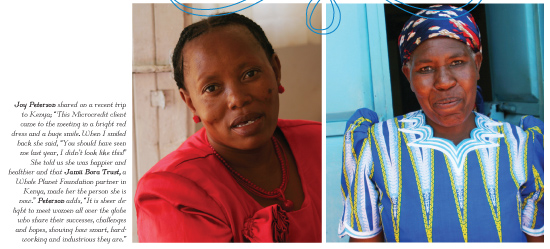
in community service activities. Joy Peterson, director of partnership
development and internal programs at the Foundation, says, “We soon
hope to include customers in our nascent Whole Foods Market Team
Member Volunteer Program … [The current program] includes a one-month
stay, in the field, in Costa Rica and Guatemala where volunteers
get to witness the impact of microcredit by meeting loan recipients
and learning directly from them. Community service activities such
as teaching literacy skills or building carbon efficient stoves
are included. Since its inception, 89 team members have provided
72,500 meals to school children, distributed 15 tons of food, built
22 carbon-efficient stoves for families, taught 114,573 classroom
hours, planted 6,490 trees, worked construction for 692 hours, and
met 510 microcredit clients. This popular program has great results
supporting communities where Whole Foods Market sources products.”
Peterson adds “Our Supplier Alliance for Microcredit vendor partners
have contributed $810,000 to date and many have witnessed their
generosity in action while visiting microcredit clients in Costa
Rica, the U.S, and Peru. These valued partners tell us that the
collaborative Supplier Alliance for Microcredit enables them to
support communities with more impact than they each could on their
own.”
Once the countries and local communities are selected, the Foundation
does a site evaluation to ensure that the area is capable of supporting
a microcredit product and that there are enough people in need.
Finally, the Foundation finds an acceptable Microfinance Institute
(MFI) partner that can support the community. This is not without
challenges. “The Programming Department of Whole Planet takes great
pains to do the research and visit local sites to find qualified
MFIs,” explains Sansone. “We limit our search to proven methods
of microfinance…few are competent and qualify to work with Whole
Planet Foundation. This search requires hard and hazardous travel
where the team is exposed to dangerous roads, unstable local politics,
felonious activities, as well infectious diseases and parasites.
In my own development career, I’ve contracted malaria twice, dengue
fever and other various unidentified illnesses, and a multitude
of amoebas, protozoan, bacteria and other unwelcome critters.”